
New Delhi, March 10: Just a few weeks ago, the sight of Iranian sailors marching along the Visakhapatnam seafront was held up as a symbol of India’s growing diplomatic heft. Dressed in crisp whites, the contingent from the IRIS Dena was participating in the prestigious MILAN naval exercise, a multilateral event designed to showcase New Delhi’s role as the “preferred security partner” in the Indian Ocean.
Nobody knew then that they were watching ghosts.
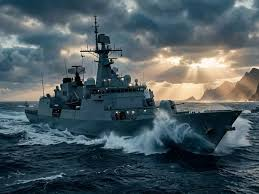
Today, those young men are dead. Their ship, a Moudge-class frigate, lies at the bottom of the ocean off the coast of Sri Lanka, torn apart by a US Navy torpedo. And the Indian government finds itself trapped in a political storm it never saw coming—caught between a superpower it has courted and an ally it cannot afford to ignore.
A Guest Torpedoed at Sea
To understand why this is more than just a distant war story, you have to look at the timeline. The IRIS Dena wasn’t some random hostile vessel lurking in the shadows. She was an invitee. Between February 15 and 25, the Dena, along with the IRIS Bushehr and IRIS Lavan, was a participant in the International Fleet Review hosted by the Indian Navy in Visakhapatnam. Photographs posted by the Indian Navy themselves showed the grey frigate gliding into port with the hashtag “Bridges of Friendship”.
Days later, the war started. On February 28, the US and Israel launched coordinated strikes on Iran. On that very same day, as missiles began to fly in West Asia, the three Iranian ships now heading home found themselves in a war zone. They reached out to Delhi for help.
India agreed. On March 1, New Delhi granted permission for the vessels to dock at Indian ports. One of them, the IRIS Lavan, made it safely to Kochi on March 4, where its crew remains housed in Indian naval facilities. But the Dena never arrived.
On the morning of March 4, roughly 20 nautical miles west of Galle in Sri Lanka’s search-and-rescue zone, a US submarine fired a Mark-48 torpedo. The heavy weapon, carrying 650 pounds of high explosive, snapped the Iranian warship in two. It sank in less than three minutes.
As of the latest counts, at least 87 Iranian sailors are dead. The Dena had been a guest of India just days prior.
The Silence from 7, Lok Kalyan Marg
In New Delhi, the silence has been deafening.
While the Ministry of External Affairs confirmed that two Indian mariners have been killed and another is missing in the wider conflict, Prime Minister Narendra Modi has yet to issue a single statement regarding the sinking of the Dena. There has been no word of condolence for the 87 sailors who marched on Indian soil, no expression of concern that a war Delhi hoped to keep at arm’s length has erupted violently in its own maritime backyard.
This reticence has sparked a political firestorm.
Leader of the Opposition Rahul Gandhi was quick to pounce, accusing the Prime Minister of having “surrendered India’s strategic autonomy.” In a blistering attack on social media, Gandhi pointed out that the conflict is no longer someone else’s problem. “The war has reached our backyard, with an Iranian warship sunk in the Indian Ocean. Yet the Prime Minister has said nothing,” Gandhi posted. “At a moment like this, India needs a steady hand at the wheel. Instead, we have a compromised PM”.
Congress president Mallikarjun Kharge went further, questioning the very foundations of the government’s maritime doctrine. “An Iranian ship, a guest of India, was returning unarmed from the International Fleet Review 2026 hosted by us and was torpedoed in the Indian Ocean Region,” Kharge said. “No statement of concern or condolence. PM Modi remains mute. Why lecture us on the doctrines of MAHASAGAR and India being a ‘Net Security Provider’ when you can’t react to what is happening in your own backyard?”
Even the government’s diplomatic outreach has been awkwardly framed. External Affairs Minister S. Jaishankar confirmed to Parliament that he had spoken to his Iranian counterpart Abbas Araghchi on March 5, and that Tehran had actually thanked India for the “humane gesture” of docking the IRIS Lavan at Kochi. But he pointedly avoided commenting on the Dena itself, admitting that maintaining high-level contact with Iranian leaders was “difficult” due to the current situation.
For the opposition, this is proof of a timid foreign policy that dares not irritate Washington.
A Strategic Backyard No More?
Beyond the political mudslinging, a more uncomfortable question is being asked by strategists: Does India actually control its own neighborhood anymore?
The Indian Ocean has long been considered New Delhi’s sphere of influence. The government’s SAGAR (Security and Growth for All in the Region) doctrine explicitly aims to position India as the first responder and net security provider in the region. Yet, when a US submarine decided to sink a vessel within spitting distance of Sri Lanka, literally in waters patrolled by the Indian Navy, Delhi was relegated to the role of a spectator.
Strategic expert Brahma Chellaney put it bluntly, calling the incident a “strategic embarrassment” for India. “By sinking a vessel returning from an Indian-hosted multilateral exercise, Washington effectively turned India’s maritime neighbourhood into a war zone, raising uncomfortable questions about India’s authority in its own backyard,” Chellaney wrote.
Retired Vice Admiral Arun Kumar Singh, who actually watched the Iranian contingent march in Visakhapatnam, expressed a more somber view. “I saw the boys marching in front of me. All young people. I feel very sad,” he told the BBC. But he also acknowledged the brutal reality of warfare: “When a shooting war is on, any ship of a belligerent country becomes fair game”.
The message from Washington appears to be precisely that. US Defense Secretary Pete Hegseth openly bragged about the kill, calling it “an incredible demonstration of America’s global reach.” General Dan Caine, chairman of the Joint Chiefs, added that the ability to “hunt, find, and kill an out-of-area destroyer is something that only the United States can do”.
Military historian Srinath Raghavan noted that while India has no *legal* responsibility for the Dena once it left Indian waters, the strategic message is impossible to ignore. “The US Navy has fired a shot across the bow aimed at all regional players, including India,” he said.
The Price of Neutrality
For New Delhi, the torpedoing of the Dena represents the collapse of a careful balancing act that has defined its foreign policy for decades.
On one hand, India has deepened defense ties with the United States through exercises like MALABAR, through intelligence sharing, and through the Quad. On the other hand, it maintains historically close political and economic relations with Tehran, which remains critical for India’s access to Central Asia via the Chabahar port and for its energy security. Over 40 percent of India’s oil imports and a massive chunk of its LPG transits through the Strait of Hormuz.
That balancing act is now broken. By staying silent on the Dena, India risks appearing subservient to Washington in the eyes of Tehran. Yet by docking the Lavan and providing sanctuary to its crew, it risks annoying an American administration that has made destroying Iran’s navy a stated war aim.
The human cost is already mounting. Jaishankar informed Parliament that two Indian mariners are dead, one is missing, and 38 Indian-flagged commercial ships, along with 1,100 sailors, are currently stranded in the conflict zone. Indian medical students in Iran are posting desperate videos online, pleading for evacuation.
Despite this, the government insists it is walking a neutral line. “Dialogue and diplomacy should be pursued to de-escalate the tensions,” Jaishankar told a raucous Parliament, interrupted by opposition sloganeering. He reiterated that India’s “overriding priority” is the safety of Indian citizens and the protection of energy supplies.
But in diplomatic circles, the perception is clear: India’s much-vaunted “strategic autonomy” has taken a direct hit.
The IRIS Dena was a guest of India. It was torpedoed by India’s strategic partner. And while 87 sailors who participated in an Indian military exercise now lie in a Sri Lankan morgue, the Prime Minister of India has not uttered a single word about them.
That silence speaks louder than any doctrine ever could.