

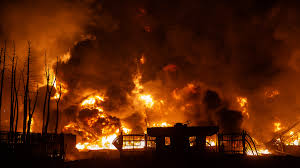
Global stocks are reeling, the price of Brent crude has shattered the $100 barrier as the intensifying military conflict between the US-led coalition and Iran enters its third week, with economists warning of a prolonged period of “stagflation” for the world economy.
Despite declarations from Washington that the campaign is nearing its conclusion, fresh rhetoric from both sides and continued attacks on shipping in the Strait of Hormuz have cemented market fears that the disruption to energy supplies will be anything but short-lived.
Oil Shock and Market Turmoil
On Friday, global stocks extended their declines for a second consecutive week. The pan-European STOXX 600 fell 0.5%, while MSCI‘s broadest index of Asia-Pacific shares outside Japan dropped 1%. The sell-off was triggered by a stark reality: the price of oil is now more than a third higher than it was when the strikes began.
Brent crude futures climbed to $101.47 a barrel, while West Texas Intermediate traded near $96.77. This marks a staggering rise from the $60 per barrel range seen at the start of 2026. The immediate catalyst is the effective blockade of the Strait of Hormuz, a chokepoint through which nearly a fifth of the world’s oil passes. Iran’s new Supreme Leader, Mojtaba Khamenei, has vowed to keep the strategic waterway closed, signaling a direct challenge to global energy supplies.
Iranian Foreign Minister Seyed Abbas Araghchi warned of an impending inflationary tsunami, claiming via social media that the market faces the “biggest shortfall in HISTORY, bigger than the Arab Oil Embargo, Iran’s Islamic Revolution, and the Kuwait invasion COMBINED”.
The $1 Trillion Question: Stagflation or Recession?
The core concern for economists and central bankers is not just the price of oil, but the length of time it remains high. Analysts are now drawing parallels to the lead-up to the 2008 financial crisis, where a doubling of oil prices preceded a severe global downturn.
Investment bank Goldman Sachs has issued a stark warning, dramatically hiking its forecast. If the Strait of Hormuz remains closed for a sustained period, prices could exceed the 2008 peak of nearly $150 a barrel. According to Goldman’s models, every sustained 10% increase in oil prices pushes inflation up by 0.2 percentage points and shaves 0.1 points off economic growth. If current prices persist, US inflation could be pushed toward 4%, severely undermining the purchasing power of American consumers.
“There are two paths at this time for markets, and the better outcome is a shorter war,” Chris Zaccarelli of Northlight Asset Management told Bloomberg. “Likewise, if the length of the military conflict stretches out much longer than expected, we could see even more negative impacts on the markets.”
FX168 analysts noted that the coming week would be critical, suggesting that the trajectory of the conflict will determine whether the global economy tips into stagflation, where growth stalls but prices remain high, or a full-blown recession.
Central Banks in a Bind
The sudden energy shock has thrown a wrench into global monetary policy. Before the conflict escalated, markets were pricing in two interest rate cuts from the US Federal Reserve by the end of the year. Now, futures markets have priced out nearly all of that easing, with traders barely anticipating a single quarter-point reduction.
Fed officials are widely expected to hold rates steady at their meeting next week, but the language of their statement will be scrutinized for how they plan to navigate the “uncertainty on both sides of the mandate,” fighting inflation while trying to avoid a spike in unemployment.
“Despite signs of economic softening, more sticky inflation data simply strengthens the idea that the Fed will remain on the sidelines,” said Ellen Zentner, chief economic strategist at Morgan Stanley Wealth Management.
The dilemma is global. The Bank of England, European Central Bank, and Bank of Japan are all due to meet next week, and are expected to hold pat as they assess the fallout. The Reserve Bank of Australia, however, is broadly expected to hike, highlighting the divergent pressures facing different economies.
The Hunt for Safe Haven
In times of extreme uncertainty, investors have flocked to the US dollar, pushing it to a three-and-a-half-month high. This strength is putting severe pressure on other currencies, with the Japanese yen sliding to its weakest level since July 2024. The euro has also tumbled to a seven-month low.
Traditional safe-haven assets are sending mixed signals. While gold is often a hedge against geopolitical risk, it has dipped slightly this week, weighed down by the strength of the dollar. Bond markets, meanwhile, are flashing warning signs. The yield on the benchmark 10-year US Treasury note remains elevated, but shorter-dated yields have spiked as traders abandon hopes for near-term rate relief.
Diplomatic Impasse
Despite President Donald Trump’s assertion that the US is “winning” and that the campaign is nearly complete, his administration has also authorized a 30-day waiver for purchases of sanctioned Russian oil in a bid to ease supply fears, a move that underscores the severity of the crunch.
However, diplomatic efforts remain stalled. Arab diplomats have reported that Iran, emboldened by its ability to disrupt the global economy, is demanding steep preconditions for any return to talks, including a halt to airstrikes and firm guarantees against future attacks.
For now, the market remains at the mercy of the headlines. “It will likely continue to be a ‘headlines-driven’ market,” said Matt Maley of Miller Tabak. “Investors are starting to worry that the situation in the Middle East could drag on for a long enough period of time for it to have an impact on the economy”.