

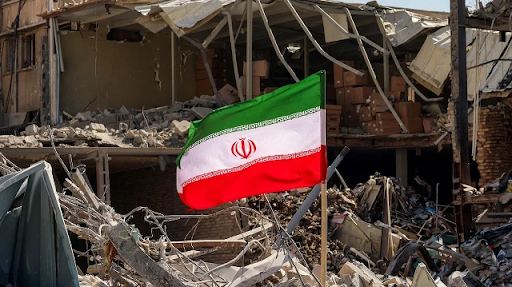
In a dramatic escalation of its diplomatic posture, Iran has formally demanded that five neighboring countries pay billions of dollars in war damages, reviving grievances rooted in decades of regional conflict.
The Islamic Republic’s Foreign Ministry submitted official notes to Iraq, Saudi Arabia, the United Arab Emirates, Bahrain, and Kuwait this week, claiming that these nations are financially responsible for what Tehran describes as “systematic destruction” caused during the Iran-Iraq war of the 1980s, as well as more recent military and economic aggression.
Speaking at a press conference in Tehran on Wednesday, Foreign Ministry spokesperson Nasser Kanaani said the claims are non-negotiable.
“These five countries have, to varying degrees, enabled or directly participated in actions that led to the loss of Iranian lives and the devastation of our infrastructure,” Kanaani said. “The blood of our martyrs and the ruins of our cities demand justice, and justice has a price tag.”
While Iran did not release a detailed breakdown of the sum, senior officials familiar with the matter, speaking on condition of anonymity, hinted that the total demand could exceed $200 billion.
Most of the claims appear tied to the 1980–1988 Iran-Iraq war, which left more than 500,000 dead on both sides. Tehran holds not only Iraq’s former Ba’athist regime responsible but also the Gulf Arab states that provided financial and logistical support to Saddam Hussein. Iranian officials have specifically pointed to Kuwait and Saudi Arabia, which helped bankroll Iraq’s war effort.
“We haven’t forgotten who funded the missiles and the chemical weapons,” Kanaani added. “Some of those governments are still in power today, and they must answer for the sins of their predecessors.”
The demand also cites more recent incidents, including the 2019–2020 attacks on Iranian oil tankers near the Strait of Hormuz, which Tehran blames on UAE-based operatives, and alleged Saudi involvement in border skirmishes.
Reaction from the targeted nations has ranged from silent to dismissive.
An Iraqi Foreign Ministry official, who requested anonymity due to the sensitivity of the issue, told reporters in Baghdad: “We are committed to resolving all outstanding issues with Iran through dialogue. But reopening the closed chapter of the Saddam era helps no one.”
Saudi Arabia and the UAE have yet to issue formal statements. However, a Gulf diplomat based in London described the move as “theatrical and counterproductive,” suggesting Tehran is using reparations to distract from domestic economic crises, including record inflation and water shortages.
Political analysts in Tehran were divided. Some called the move a long-overdue reckoning, while others dismissed it as a populist gesture ahead of critical parliamentary elections next spring.
“This is saber-rattling with a calculator,” said Fatemeh Hosseini, a Tehran-based political commentator. “Iran knows full well it will never collect a cent from Gulf states. But the narrative of victimhood resonates at home.”
Still, the move complicates recent efforts at rapprochement. Just last month, Iran and Saudi Arabia held a fifth round of normalization talks in Beijing, and trade between Iran and the UAE hit a five-year high.
As of Thursday morning, no formal response had been issued by the United Nations or the International Court of Justice. But legal experts say Iran faces an uphill battle: the statute of limitations on most war-related claims has long expired, and none of the accused nations have consented to binding arbitration.
For now, the demand remains just that a demand. But in the combustible politics of the Middle East, even old wounds can be reopened with startling speed.