
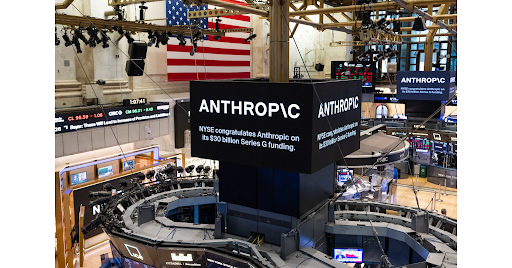
In a move that caught even seasoned tech analysts off guard, Anthropic has ripped the veil off a staggering $1.5 billion joint venture with a consortium of Wall Street heavyweights. The deal, announced early Tuesday, marries the AI firm’s most advanced language models with the high-octane, number-crunching machinery of global finance, and the trading floors are already buzzing.
Let’s be honest: Silicon Valley and Wall Street have been dancing around each other for years. But this? This is a full-blown merger of minds. The partners, a syndicate led by Jane Street, alongside quantitative hedge fund legends Renaissance Technologies and the investment banking arm of Morgan Stanley, are betting that Anthropic’s tech can do more than just write sonnets or summarize emails. They want it to trade.
The venture, code-named “Project Cronus” after the Titan of time and wealth, will pour $1.5 billion over three years into building a custom, ultra-low-latency version of Anthropic’s Claude model. The goal? Real-time risk analysis, automated corporate bond trading, and here’s the kicker, a proprietary “macro-sentiment engine” that scans global news, central bank minutes, and even satellite imagery to predict market moves seconds before they happen.
“This isn’t a chatbot playing dress-up as a quant,” said Mira Chen, Anthropic’s head of strategic partnerships, in a phone interview that crackled with barely contained excitement. “We’re talking about a model that understands counterparty risk, regulatory nuance, and probability distributions in ways that make current algorithmic trading look like an abacus. The firms came to us. They didn’t ask for a demo. They asked for a dedicated instance.”
The announcement came on a sleepy Tuesday morning, but by midday, you could feel the static in the air. In the lobby of Anthropic’s San Francisco offices, I watched a parade of dark suits and firm handshakes, a rare sight in a city more used to hoodies and sandals. One junior partner from a participating firm, who spoke on condition of anonymity, told me, “We’ve been reverse-engineering every AI research paper for two years. This is us finally admitting that we can’t build it ourselves. Anthropic has the safety architecture we need to satisfy regulators, plus the raw horsepower.”
Ah, yes, regulators. Because nothing gets the Fed and the SEC quite as twitchy as black-box AI moving billions of dollars unsupervised. Anthropic is leaning hard into its “Constitutional AI” framework, promising that the Cronus model will have hard-coded circuit breakers: it can recommend a trade, but it can’t execute without a human override; it can flag systemic risk, but it has to explain its reasoning in plain English.
Whether that will be enough to soothe jittery compliance departments remains to be seen. One erstwhile hedge fund manager, now a consultant, laughed when I read him the details. “Oh, sure,” he said. “A kill switch. Because no one on a trading floor has ever disabled a safeguard to chase alpha. But I give them credit, this is the first time an AI lab has put real skin in the game on live markets.”
Not everyone is cheering. Across town, a rival AI firm’s employee, one whose company has famously slow-walked financial applications, texted me a single line: “This is how you get an AI-driven flash crash.” The fear is real. If Anthropic’s model catches a false signal, and multiple partner firms act on it simultaneously, the cascading effect could be violent. The consortium acknowledges the risk but points to simulation results that claim their system would have prevented the 2010 Flash Crash.
For the rest of us, the people not parsing bond spreads in a Jersey City high-rise, the biggest question is whether this is the beginning of the end for human traders on the floor. On that, Anthropic’s Chen was surprisingly blunt. “Look, if your job is to scan 10,000 10-K filings a day and find anomalies, that job is already gone. But if your job is to ask, ‘What does this anomaly mean for the supply chain in Southeast Asia?’ that’s still a human calling the shots. For now.”
The venture launches with an initial $400 million funding in Q2. If the pilot proves stable, the full $1.5 billion will be deployed by late 2026. Until then, Wall Street will be watching not with calculators, but with bated breath. Because the AI revolution just walked onto the trading floor, and it’s wearing a tailored suit.