
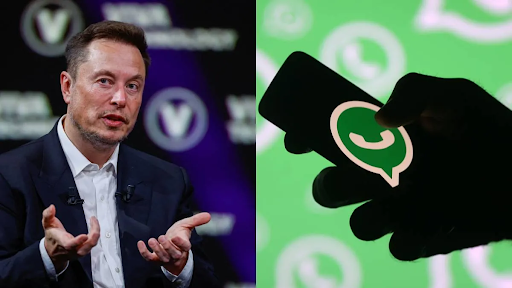
A fresh digital war of words erupted late Wednesday after Elon Musk, the volatile CEO of Tesla, SpaceX, and the recently rebranded X, publicly declared that Meta-owned WhatsApp is a security liability, urging his 170 million followers to abandon the messaging platform immediately.
“Cannot trust WhatsApp,” Musk posted on X. “Meta owns it. Your messages are not private.”
The broadside, which garnered over 45 million views within six hours, rekindled a long-simmering feud between Musk and Meta CEO Mark Zuckerberg, a rivalry that has previously involved canceled cage fights, dueling social networks, and competing artificial intelligence models.
Meta’s communications team did not issue a formal press release but responded aggressively through a series of posts on both WhatsApp’s official X account and its own Threads platform. The company insisted that Musk’s claims are “technically false and dangerously misleading,” pointing to WhatsApp’s longstanding default end-to-end encryption E2EE.
“Every single private message, photo, video, voice note, and document you send on WhatsApp is protected by the same Signal Protocol that Elon Musk claims to support,” a Meta spokesperson told journalists via email. “Not even WhatsApp or Meta can read your messages. That is mathematics, not marketing.”
Musk, however, has remained defiant. In follow-up replies to his original post, he wrote: “End-to-end encryption means nothing when the client app can silently update itself to send plain text tomorrow. Closed source = blind trust. Don’t be blind.” He then added a one-word post: “Signal,” referring to the open-source encrypted messaging app that has become a favorite of security professionals and journalists.
The clash exposes a deeper tension in the tech industry: the battle between convenience and verifiable security. WhatsApp, with over 2 billion users globally, relies on closed-source code, meaning outside researchers cannot fully inspect every version of the app for backdoors or vulnerabilities. Signal, by contrast, publishes all its client and server code publicly. Musk has endorsed Signal repeatedly since 2020, famously tweeting “Use Signal” in the wake of the Capitol Hill riots.
Privacy advocates are divided. Matthew Green, a cryptographer at Johns Hopkins University, noted that while WhatsApp uses the same encryption protocol as Signal, the Meta-owned app’s metadata collection remains a legitimate concern. “WhatsApp cannot read the content of your messages,” Green wrote on his blog. “But it knows who you talk to, when, and for how long. That’s metadata, and Meta absolutely uses that to build behavioral profiles. Musk isn’t entirely wrong, he’s just oversimplifying.”
Meta executives pushed back harder on Thursday. Will Cathcart, head of WhatsApp, posted a technical breakdown on Threads: “The idea that we could ‘silently update’ the app to bypass encryption without every security researcher on earth noticing is absurd. Our code is not open source, but we publish technical white papers, maintain a transparency report, and have independent auditors verify our encryption every quarter. Trust is built on proof, not billionaire vibes.”
Cathcart also pointed to a 2021 legal attempt by the Trump administration to force WhatsApp to break encryption for surveillance, an attempt the company fought and defeated in court. “We’ve shown our teeth when governments demand backdoors. Elon hasn’t asked us a single question about our security architecture. He just tweets.”
The exchange quickly turned personal. When a user asked Musk whether he would accept a live, public debate with Zuckerberg on encryption, Musk replied: “Zuck couldn’t explain the Diffie-Hellman key exchange if his life depended on it. Let him audit Signal’s open-source code first. Then we talk.”
Meta declined to comment further on Musk’s characterizations but reiterated that WhatsApp users can verify its end-to-end encryption through a safety feature that matches 60-digit security codes with a contact in person or via a trusted channel.
For ordinary users, the clash has generated fresh confusion. A YouGov flash poll conducted Thursday morning found that 34% of U.S. WhatsApp users were “less confident” in the app’s privacy after reading Musk’s claims, though only 12% said they planned to switch to Signal or another alternative.
“I use WhatsApp because everyone in my kids’ soccer group uses it,” said Laura Chen, 42, a parent in Austin, Texas. “I don’t love that Meta owns it, but switching is like asking a whole neighborhood to move houses at the same time. Musk yelling about it doesn’t make that practical.”
Security experts offer a more nuanced take. The Electronic Frontier Foundation (EFF) rates both Signal and WhatsApp as “highly secure” for content privacy but notes that Signal collects almost no metadata—only the last time a user connected and the date an account was created. WhatsApp, by contrast, collects device identifiers, IP addresses, payment information (where used), and transaction data.
“The real question is not whether Meta can read your messages,” said Eva Galperin, EFF’s director of cybersecurity. “It cannot. The question is whether you trust a company that profits from behavioral data to never change that arrangement after a merger, a legal subpoena, or a change in leadership. That’s a question of trust, not technology. And Elon Musk has spent his entire career arguing that you should never trust large corporations.”
As of press time, Signal’s daily download rate had spiked 780% on iOS and 420% on Android, according to preliminary data from app analytics firm SensorTower. Musk has not replied to requests for comment on those figures. He instead posted a meme: a photograph of a locked metal box next to a cardboard box labeled “WhatsApp (Trust Me, Bro).”
Zuckerberg, notably, has remained silent on his own platforms. The last public post on his Facebook page was a photograph of his family’s new puppy, posted three days ago.