

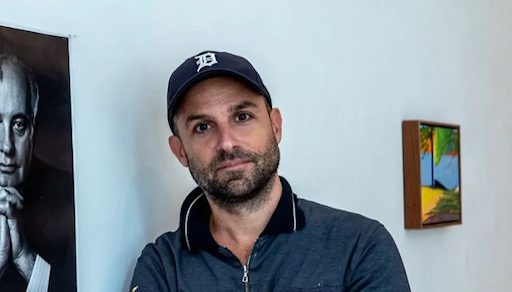
The traditional artist has generated millions by embracing scarcity and community, even as his prices continue to climb.
As artificial intelligence reshapes creative industries, the conventional wisdom suggests that human artists are fighting a losing battle against the algorithm. Tell that to Tyler Loftis. The traditional painter has generated $2.5 million in sales and is proving that the human touch doesn’t just have a place in the market it commands a premium.
While tech evangelists predict a future where AI generates everything from corporate logos to cinematic masterpieces, Loftis’s work is becoming more valuable precisely because it is human, physical, and scarce. His current paintings start at $25,000, and some of his early works, which initially sold for roughly $2,000, are now valued at nearly $50,000.
A Simple, Unreplicable Formula
Loftis’s business model stands in stark contrast to the “move fast and break things” ethos of Silicon Valley. He produces only about 14 paintings a year, a deliberate strategy that ensures each piece is an event. “Any sale as an artist is major,” Loftis explains . “It is a big deal because all of a sudden this thing lives outside of your world, and somebody else has deemed it important enough to be in their world.”
This philosophy extends to his view on the tools of his trade. In a world of complex digital prompts and generative adversarial networks (GANs), Loftis’s medium is strikingly simple.
“I have a piece of wood with some hair on the end, dirt mixed with oil,”Loftis says, describing his materials .”I don’t see that going away anytime soon. You have this direct passport to a first-hand account of what it was like to live all the way going back to 40,000 years in the cave.”
This tangible connection to history and human experience is something that a diffusion model cannot replicate.
Democratizing Art, Building a Community
Beyond his studio practice, Loftis has created a business infrastructure that empowers other artists to thrive by following similar principles. In 2015, he founded AllArtWorks, a platform designed to bypass the traditional, often exclusionary, gallery system.
AllArtWorks is not a free-for-all. A board of curators vets submissions, accepting about 60% of artists to ensure quality and fair pricing . The platform takes a 40% commission but handles the logistics of framing and shipping. More importantly, it solves the two most uncomfortable conversations for new artists: “How much is it worth?” and “Is it any good? .
In 2018, Loftis launched Portraits For Purpose, a charity initiative where he paints famous figures and auctions the works, with proceeds going to the subjects’ chosen charities. This not only expands the reach of art but also builds goodwill and connects his work to broader cultural narratives a level of emotional intelligence and genuine human connection that AI agents simply cannot simulate.
Why the Premium Price Persists
Loftis’s success offers a powerful lesson for creatives navigating the rise of AI. In a world where text-to-image generators can create infinite variations of a portrait in seconds, the value of a piece of art shifts away from mere novelty and toward authenticity and scarcity.
The artist argues that scarcity and authentic human connection drive premium valuation, suggesting that creatives must cultivate a distinct personal narrative . The painstaking process of a human creating something unique over weeks or months becomes a luxury good in a market flooded with algorithmically generated content. This aligns with the view that physical, deeply personal elements of a craft create a defensible market position that cannot be easily automated.
The tools of painting have remained unchanged for millennia, and Loftis believes that this historical continuity grants his work a permanence and value that digital files lack.
As generative AI continues to disrupt industries, Loftis is not fighting the current. He is ignoring it entirely and building a fortress on the bedrock of human creativity. And the market is responding by paying more.