
The world’s biggest electric vehicle maker is done waiting. BYD just confirmed it’s looking at building cars in Canada, if a struggling automaker happens to be for sale along the way? Well, they’re open to that too.
You have to hand it to Stella Li. The BYD executive vice president was in São Paulo this week, ostensibly to talk about Brazil, when she casually dropped what amounts to a grenade into the North American automotive industry.
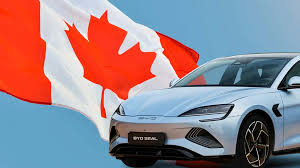
China’s BYD, the company that sold more than 2.2 million battery-electric vehicles last year, comfortably beating Tesla, is actively studying plans to build a manufacturing plant in Canada. And while they’re at it, they’re keeping their options open for buying out an established global automaker.
“We’re open to every opportunity we have,” Li told reporters. “We’ll see what benefits us.”
For anyone who’s been watching BYD’s relentless global expansion over the past five years, this shouldn’t come as a shock. The Shenzhen-based giant already dominates China’s EV market, has a growing footprint across Southeast Asia and Latin America, and is ramping up production in Europe. North America has always been the missing piece.
What’s striking is how direct Li was about the terms. Canada has spent the better part of two years trying to figure out how to attract Chinese EV investment while protecting its own interests. Ottawa has floated the idea of joint ventures pairing Chinese manufacturing muscle with Canadian partners. Li essentially laughed that off.
“I don’t think a JV will work,” she said flatly.
BYD wants to own its factory, full stop. It’s not hard to understand why. The company does things differently from most automakers. They manufacture their own batteries, their own motors, their own power electronics, even their own semiconductors. Nearly the entire supply chain lives under one corporate roof. Throwing a joint venture partner into that mix would be like trying to graft a branch onto a tree that already has its own root system. Technically possible. Practically a mess.
The timing here matters. Back in 2024, when Ottawa slapped a 100 percent tariff on Chinese EV imports, BYD essentially shelved its Canadian market plans. Why bother fighting through a doubling of costs when there were friendlier markets to pursue?
But something shifted in January. Ottawa quietly agreed to exempt up to 49,000 Chinese-built vehicles annually from that tariff wall. Those cars will now enter at the standard 6.1 percent rate, a dramatic reversal that basically reopened the Canadian market overnight. The quota grows to roughly 70,000 vehicles over five years, with most of those expected to be affordable models priced under $35,000.
Suddenly, Canada looks a lot more interesting.
The factory talk is one thing. The acquisition chatter is something else entirely. Li acknowledged that BYD is actively evaluating potential purchases of established automakers, and anyone with a spreadsheet can see why. Several American, European, and Japanese manufacturers are bleeding cash trying to maintain both combustion and electric vehicle production simultaneously. It’s an expensive balancing act, and not everyone is going to make it.
There’s precedent here. Zhejiang Geely, another Chinese giant, bought Volvo from Ford back in 2010 when the Swedish brand was struggling. Today, Volvo is profitable and fully committed to electrification. BYD, with its massive scale and deep pockets, could attempt something similar.
The company is already one of three finalists bidding for the Nissan-Mercedes COMPAS plant in Mexico a 230,000-unit facility that would give whoever wins it instant production capacity and a trained workforce. Buying an existing operation is faster than building from scratch, and BYD appears to be applying that logic globally.
Now, about that US market everyone keeps asking about. Not happening, at least not anytime soon. Li called the US a “complicated environment,” which is diplomatic code for “they’ve made it abundantly clear they don’t want us there.” Chinese EVs face tariffs exceeding 100 percent and a ban on connected car technology that effectively locks them out. Even if BYD built in Canada, the political blowback from shipping those cars south would be immediate and fierce. Donald Trump has already slammed Canada’s tariff deal with China and threatened consequences.
So Canada it is, for now. The question is whether BYD arrives as a builder, a buyer, or both.
There’s some history here worth remembering. BYD opened an electric bus assembly plant in Newmarket, Ontario, back in 2019. The plan was to supply the Toronto Transit Commission. It ended up producing exactly ten buses before shutting down, plagued by quality complaints and the broader political chill between Ottawa and Beijing. A passenger vehicle factory would be a very different proposition, and BYD in 2026 is a very different company than the one that stumbled with buses seven years ago.
The broader picture is that BYD isn’t alone in eyeing Canada. At least three other Chinese brands are preparing to launch here by next year, with regulatory approvals and dealer networks already in motion. Chery is bringing multiple sub-brands. Geely has trademarked Zeekr, its premium Chinese marque. The wave is coming.
What does this mean for Canadian consumers? More choice, almost certainly at lower prices. BYD’s strength has always been making decent electric vehicles affordably, something the established automakers have struggled to do. A Seagull, their tiny city car that sells for around $12,000 in China, would fundamentally alter the entry-level market here if it ever lands.
Li also dropped one more intriguing hint before wrapping up in São Paulo. BYD is examining options to enter competitive motorsport, including Formula One and endurance racing. Nothing decided yet, she cautioned, but don’t be surprised.
“Don’t be surprised,” she said. “We’re still working on it.”
For an automaker that started out making rechargeable batteries and has spent the past two decades methodically building itself into the world’s largest EV producer, Formula One would be a flex of the highest order. It would also be a statement: we’re not just a Chinese company anymore. We’re a global automaker, and we’re here to stay.
Canadian policymakers are now left to figure out what that means for them. The dealers are already preparing. The consumers are watching. And BYD, as usual, is moving fast.
Stella Li made one thing clear in São Paulo. BYD isn’t asking permission. They’re not looking for partners. They’re evaluating their options, and when they’re ready, they’ll move.
The only question is whether Canada is ready for them.