

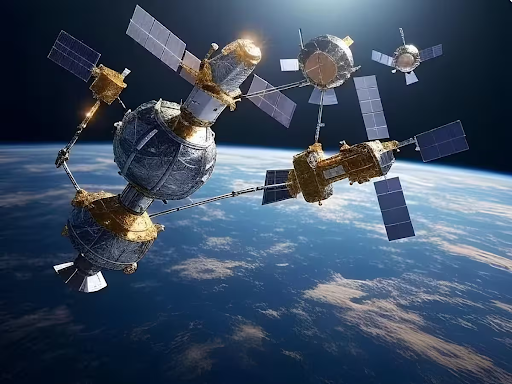
A Russian private aerospace firm has successfully launched the first operational batch of its Rassvet satellite constellation, marking Moscow’s most significant step yet in its quest to build a homegrown rival to Elon Musk’s Starlink network.
In a launch that took place Monday evening from the Plesetsk Cosmodrome in northern Russia’s Arkhangelsk region, a Soyuz-2.1b carrier rocket delivered 16 broadband internet satellites into low Earth orbit. The spacecraft, developed by the private company Bureau 1440, successfully separated from the launch vehicle and was promptly taken under control by the company’s mission control center.
For Bureau 1440, the event represents far more than a routine deployment. It is the culmination of 1,000 days of engineering work that began with experimental launches in 2023 and 2024. “The launch of the first satellites of the target constellation marks the transition from experiments to the creation of a communications service,” the company stated on its Telegram channel.
A Constellation Takes Shape
The project, named Rassvet, Russian for “dawn,” is designed to provide high-speed internet access across Russia’s vast territory and, eventually, anywhere on Earth. The 16 satellites launched this week are the vanguard of a much larger fleet. According to the company’s roadmap, commercial services are slated to begin in 2027, supported by an initial constellation of more than 250 satellites. By 2035, the network could expand to approximately 900 units.
The scale of the ambition, however, highlights the scale of the challenge. SpaceX’s Starlink currently operates more than 7,000 satellites in low Earth orbit, with over 10,200 spacecraft deployed to date. While Russia’s target numbers are smaller, the strategic intent is unmistakable.
“We will respond to Starlink with the Rassvet project,” Roscosmos CEO Dmitry Bakanov said last May, underscoring the government’s backing for the initiative.
Technology and Investment
The Rassvet satellites incorporate a suite of advanced technologies aimed at delivering broadband speeds comparable to terrestrial fiber networks. According to technical specifications disclosed by the company, the spacecraft are equipped with 5G NTN (non-terrestrial network) communications systems, next-generation laser terminals for satellite-to-satellite links, upgraded power supply systems, and plasma propulsion units for orbital maneuvering.
The financial commitment behind the project is substantial. The Russian government has allocated 102.8 billion rubles (approximately $1.26 billion) for the development of Rassvet, while Bureau 1440 plans to invest an additional 329 billion rubles ($4 billion) of its own funds through 2030.
Strategic Autonomy and Military Implications
While officially intended for civilian use, providing connectivity for aviation, maritime transport, remote industrial operations, and emergency services, the project carries clear strategic weight. The Kremlin has grown increasingly sensitive to its dependence on foreign-controlled space assets, particularly in light of the role Starlink has played in the Ukraine conflict.
Ukraine has utilized more than 50,000 Starlink terminals for military communications since the war began, while Russian forces have attempted to procure and use the system illegally. In February, Musk’s SpaceX moved to restrict Russian access to Starlink terminals in the conflict zone, effectively denying Moscow a critical communications tool on the front lines.
The episode appears to have accelerated the Kremlin’s push for an indigenous solution. Alexei Shelobkov, CEO of Bureau 1440’s parent company ICS Holding, told the Russian business daily Kommersant that the coming phase of deployment will involve “dozens of launches” as the constellation expands.
Orbital Ambitions
The launch had been delayed from its original schedule late last year, reflecting the technical complexities involved in developing a low Earth orbit broadband network from a standing start . Bureau 1440, founded in 2020, has moved with notable speed for a private Russian aerospace venture, though significant hurdles remain.
According to Russian space commentator Vitaly Egorov, the system will require approximately 250 satellites in orbit before it can function as a truly operational communications network. That threshold is expected to be crossed next year, when commercial operations are scheduled to begin.
As the Soyuz rocket’s upper stage released its payload into the darkness above the Arctic Circle, Bureau 1440’s mission control center confirmed that all 16 satellites were responding to commands. The spacecraft will now undergo system checks before maneuvering to its target orbits. For a Russian space industry long defined by legacy Soviet-era infrastructure, the Rassvet project represents a bid to compete in the new era of commercial space-based connectivity, one launch, one satellite, one thousand days at a time.