
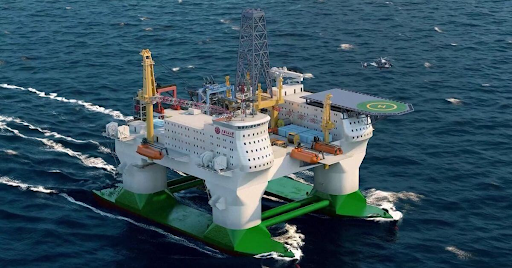
Imagine a man-made island, nearly the size of two football fields, standing firm in the middle of a raging ocean. Not just bobbing around, but stable. Calm. Even as a Category 5 super typhoon whips up waves the height of three-story buildings. This isn’t concept art or a movie prop. It’s real. And it just broke ground in Shanghai.
On March 27, 2026, alongside the inauguration of Shanghai Jiao Tong University’s Institute of Deep-Sea Science and Engineering, a groundbreaking new facility officially began construction. Officially named the “All-Weather Stationary Floating Research Facility for Deep Seas,” this platform has already earned a bold title: the world’s first floating artificial island designed specifically for year-round, all-weather deep-sea scientific research.
So what makes it so special? Let’s just say it doesn’t run from bad weather—it stays put and gets the job done.
A floating fortress that thinks like a ship
Traditional research vessels have a major weakness: they have to flee when the ocean gets angry. Typhoon coming? Pack up the lab and steam hundreds of miles off course. That means interrupted experiments, lost data, and months of planning down the drain.
The new floating island flips that script.
Engineers designed it with a semi-submersible twin-hull configuration. Think of it as part ship, part offshore platform. When it needs to move, it sails like a normal vessel. Once it reaches its target location, it partially submerges, sitting low and heavy in the water, just like a natural island.
That’s where the name comes from. It’s not an island made of dirt and rock. It’s an engineered one that behaves like solid ground.
According to the research team at Shanghai Jiao Tong University, the platform has a deadweight tonnage of 78,000 tons and a deck large enough to support multiple heavy-duty research rigs. Its endurance? 120 days at sea without resupply. And yes, it’s built to survive typhoons with wind speeds equivalent to a Category 5 hurricane. That’s sustained winds over 250 kilometers per hour.
Finally, a stable table for deep-sea work
If you’ve ever tried to thread a needle on a moving bus, you have some idea of what scientists face when lowering heavy equipment into the deep ocean from a traditional ship. Waves cause constant motion. Even small rolls can make precision work nearly impossible.
This floating island solves that problem with something called a “moon pool”—a large vertical shaft running right through the center of the hull. Through that opening, the platform can lower loads of up to 300 tons to depths of 6,000 meters.
To put that in perspective: that’s like lowering a fully loaded Boeing 747 straight down through the hull and into the abyss, with surgical precision.
Professor Yang Jianmin, chief scientist for the facility, told local media that this capability is a game-changer for deep-sea mining, oil exploration, and studying microorganisms that live under extreme pressure. “You’ll never truly understand what happens on the seafloor unless you can stay there and watch it happen,” a PhD student working on the project explained.
More than just ocean science, a weather sentinel
While the platform’s core mission is deep-sea research, its impact may be felt most immediately by people who never set foot on a ship. Specifically, anyone living in coastal regions worried about typhoons.
Right now, typhoon forecasting models suffer from a lack of real-time data over open water. Most measurements come from satellites or occasional aircraft reconnaissance. But a floating island that can intentionally position itself in the path of an incoming typhoon and just wait? That changes everything.
Researchers expect the facility to dramatically improve typhoon intensity and track forecasts. Better forecasts mean earlier evacuations, smarter disaster prep, and ultimately, fewer lives lost.
And that’s just one application. The onboard laboratories, 4,000 square meters worth, will also study marine energy, underwater acoustics, deep-sea biology, and even the origins of life in hydrothermal vents.
2030: When the island comes to life
Construction is just beginning. The current timeline puts completion around 2030. That sounds like a long way off, but for an engineering project of this scale, effectively building a floating city block that can survive the worst the ocean can throw at it, six years is remarkably fast.
Shanghai Jiao Tong University has already set up a dedicated institute to run the facility, with a “build and research simultaneously” model. In other words, even while construction continues, small-scale experiments and technology tests are already being planned.
For most people, this is just another headline about Chinese engineering prowess. But for oceanographers, climate scientists, and deep-sea explorers around the world, it’s something else entirely. It’s the first real taste of what it means to stop visiting the deep ocean and start living there.