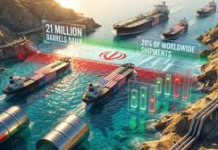
The world’s most important energy artery has become a no-go zone.
Iran’s Revolutionary Guard Corps announced Wednesday morning that it has seized “full control” of the Strait of Hormuz, effectively halting traffic through the waterway that carries one-fifth of the world’s oil. The declaration isn’t just rhetoric. Senior IRGC naval official Mohammad Akbarzadeh confirmed that Iranian forces have already targeted more than ten oil tankers that failed to comply with warnings, striking them with missiles and leaving them burning.
“We will not allow a single drop of oil to flow from this region,” a senior IRGC commander warned, predicting oil prices could hit $200 per barrel in the coming days. For global business, the nightmare scenario energy traders have feared for decades has arrived.
The numbers tell a stark story. Where roughly 80 oil and gas carriers normally transit the strait daily, just two passed through on Monday, and only one additional vessel has attempted the journey since. Tanker traffic has plummeted nearly 80% compared to normal levels. Ships aren’t moving because insurers have either canceled coverage or imposed massive surcharges, and crew members are refusing to sail into a war zone.
Oil Prices Surge as Production Grinds to a Halt
The market reaction has been swift and severe. Brent crude hit $85 per barrel on Tuesday, up from $66 at the beginning of February, a nearly 30% surge in just weeks. But the price spike is only part of the story. The real crisis is physical: oil is being produced, but it can’t get out.
Iraq, OPEC’s second-largest producer, has begun shutting crude production at its biggest oilfields, including the massive Rumaila field and the West Qurna 2 project. The reason isn’t a lack of demand or technical problems; it’s simple geography. With the Strait of Hormuz effectively closed, storage tanks are filling up, and there’s nowhere to put the oil. When complete, the halts will stop a majority of the country’s output, with shutdowns potentially extending to two-thirds of Iraq’s total production in the coming days.
Only three tankers are currently berthed at Iraq’s seven loading points in the Basrah terminal. At least ten vessels that loaded Iraqi oil since February 21 remain stuck in the Persian Gulf, unable to transit.
Saudi Arabia is scrambling for alternatives. The kingdom is exploring using the East-West Pipeline that runs across the country to the Red Sea port of Yanbu, allowing crude to bypass Hormuz entirely. But the pipeline’s capacity is limited, and the route isn’t risk-free. Iran could target it directly or task Yemen’s Houthi rebels with strikes.
“With the Strait of Hormuz still inactive, the clock is ticking,” JPMorgan Chase analysts warned in a note.
Freight Rates Explode as Shipping Paralysis Sets In
The shipping crisis has created its own financial shockwave. Day rates for very large crude carriers to deliver Middle East oil to China have hit approximately $481,000, a 3.3-fold increase in just two weeks. Between six and twelve VLCCs remain in the Gulf and are available for booking, a fraction of normal availability.
The insurance situation has compounded the crisis. Maritime insurers have expanded the areas where they charge war risk premiums to include larger portions of Omani waters. Some have simply canceled coverage altogether.
Major container shipping lines are withdrawing entirely. Danish giant Maersk announced Sunday it would suspend vessel crossings in the strait, rerouting all services around the Cape of Good Hope. Mediterranean Shipping Company followed suit, suspending all bookings for worldwide cargo to the Middle East region until further notice.
That detour around southern Africa adds approximately two weeks to voyage times and dramatically increases fuel costs. For an industry already stretched thin, it’s a brutal blow.
Peter Tirschwell, vice president for maritime and trade at S&P Global Market Intelligence, put it bluntly: “The idea that this was going to be a calmer year, that freight rates were going to settle down, that supply chains might begin to return to normal all that is totally off the
L table now. Here we are, back in the soup”.
Asia Faces Energy Supply Emergency
The blockade’s heaviest impact will land in Asia, where over 80% of oil and gas trans
ported through the strait was destined in 2024. China, India, Japan, and South Korea are scrambling.
South Korea imports approximately 70% of its crude oil from the Middle East and relies on the region for the vast majority of its LNG. Japan is even more exposed, depending on the Middle East for over 90% of its oil. The Korea Ocean Business Corporation warns that if transit restrictions continue for a month, global crude oil shipments could be disrupted by roughly 300 cargoes and LNG shipments by 100 cargoes.
Both governments stress they hold strategic reserves. South Korea says it has 208 days’ worth of oil under International Energy Agency standards. But reserves are a buffer, not a solution. If the blockade persists, those stockpiles will drain, and replacement supplies will be scarce.
China faces a different dilemma. Over half its seaborne oil imports come from the Middle East, with roughly a quarter originating from Iran. Beijing is quietly pressuring Tehran to avoid disrupting Qatar’s LNG exports, which account for about 30% of China’s supply. Foreign Ministry spokesperson Mao Ning offered a carefully worded response when asked about the crisis: “All parties have a responsibility to ensure stable and smooth energy supply”.
India, with lower reserves than its Asian neighbors, may be the most vulnerable if the conflict drags on.
Beyond Oil: The LNG, Fertilizer, and Food Fallout
The crisis extends far beyond crude markets. Natural gas is feeling acute strain, with European prices up nearly 50% and Asian prices up 40% since the conflict began.
QatarEnergy, the world’s largest LNG exporter, suspended operations at its Ras Laffan facility following a drone attack and declared force majeure to affected buyers. The facility accounts for roughly one-fifth of global LNG supply. Australia and the US may be able to compensate for some lost volumes, particularly for allies like Japan and Korea, but the gap will be hard to fill.
Fertilizer markets are also in the crosshairs. Kirill Dmitriev, CEO of the Russian Direct Investment Fund, warned that approximately 44% of global sulfur, 31% of urea, 18% of ammonia, and 15% of phosphates transit the region. Those are critical components for global agriculture. “Major commodity and agricultural shocks ahead,” he predicted.
If fertilizer exports are disrupted, food prices will follow a painful echo of the supply chain shocks that followed Russia’s invasion of Ukraine.
Saudi Arabia’s Ras Tanura refinery, one of the world’s largest, has been hit and is reducing output. The UAE’s Fujairah oil facility, another critical piece of regional infrastructure, caught fire after a drone strike. Jebel Ali Port, the Middle East’s largest container hub and a critical node in global trade, has suspended operations.
“The damage to global production could tilt the balance in global oil markets toward undersupply,” said Noah Barrett, research analyst at Janus Henderson.
For now, the world watches the Strait. Ships are idle at anchor. Insurers calculate risks. Traders refresh screens showing prices climbing toward levels that will ripple through every industry and household. The nightmare scenario is here. The question now is how long it lasts.