
The world of work is changing faster than at any other time in history. Degrees, titles, and years of experience still matter—but they no longer guarantee relevance. In today’s economy, skills are the real currency, and those who fail to build them risk being left behind.
The Shift From Credentials to Capability
For decades, success followed a predictable path: get a degree, land a job, climb the ladder. But automation, artificial intelligence, and digital transformation have disrupted this model. Employers now ask a different question: What can you actually do?
Companies are prioritizing practical ability over paper qualifications. A candidate who can analyze data, write clean code, manage customers, or solve real problems often outperforms someone with impressive credentials but limited hands-on skill. This shift has made skills—not job titles—the true measure of value.
Why Skills Matter More Than Ever
Skills future-proof careers. Technologies evolve, industries change, and job roles disappear—but adaptable skills remain useful across fields. Critical thinking, communication, digital literacy, and problem-solving are transferable and resilient.
In contrast, relying solely on a single qualification can be risky. When roles become automated or outsourced, those without adaptable skills struggle to compete. The modern workforce rewards people who can learn continuously and apply knowledge in real-world situations.
Learning Is No Longer Optional
In the past, learning ended after graduation. Today, it’s a lifelong requirement. Online platforms, short courses, certifications, and hands-on projects make it easier than ever to upskill or reskill. The advantage goes to those who take initiative rather than waiting for formal training.
This doesn’t mean abandoning education—it means complementing it with practical skills. Employers increasingly look for proof: portfolios, projects, measurable results, and demonstrated impact.
Skills Create Opportunity
Putting skills first levels the playing field. You don’t need elite connections or prestigious institutions to succeed. What matters is your ability to deliver value. Freelancers, remote workers, and entrepreneurs are thriving because skills allow them to compete globally.
Those who invest in learning stay relevant. Those who don’t risk stagnation.
The Bottom Line
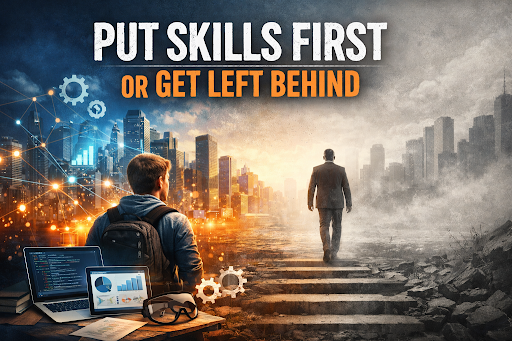
The message is clear: put skills first or get left behind. The future belongs to learners, doers, and problem-solvers. In a fast-changing world, the most powerful asset you can own is the ability to adapt—and that starts with building the right skills.