
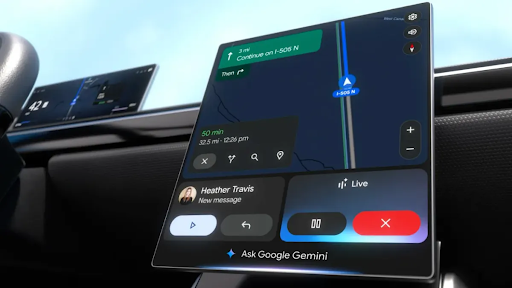
Google has begun rolling out its Gemini AI assistant to vehicles running the native Android Automotive operating system, the company confirmed this week. The upgrade, which replaces the classic Google Assistant in select car models, introduces conversational AI and deeper vehicle control for drivers.
The rollout covers Volvo, Polaris, and General Motors vehicles first, with Renault, Nissan, Ford, and Lincoln to follow later in 2026. Unlike Android Auto, which requires a phone connection, Android Automotive is built directly into the car’s infotainment hardware. That allows Gemini to manage core vehicle functions such as climate control, window adjustments, seat heating, and even driving mode settings.
“We’re moving from simple voice commands to an assistant that understands context,” a Google spokesperson told Telecompaper. “You can say ‘navigate to the nearest charger and warm up the seats’ in one sentence, and Gemini will execute both.”
Early test drivers have reported that Gemini handles natural conversation better than its predecessor. Interruptions, pauses, and follow-up questions no longer break the command chain. For example, a driver can ask “What’s my battery level?” and then immediately add “route me to a fast charger” without repeating the wake word.
Perhaps more significant for those driving through rural or tunnel-heavy routes is Gemini’s offline capability. Core commands, including navigation rerouting and basic climate changes, are processed on-device. Only complex queries, such as live traffic re-routing or restaurant reviews, require a cellular connection.
Google has also built in vehicle-specific awareness. Gemini can read tyre pressure, fuel or charge status, and maintenance alerts. In some models, it proactively suggests actions. “You’re down to 12% battery, and the next charger on your route is 30 kilometres away. Would you like to adjust your speed to Eco mode?” is one example cited in Google’s internal testing.
Not all features will be available immediately. Multimodal interaction — where an in-cabin camera detects driver attention and lowers audio volume or pauses a podcast — is limited to newer models such as the Volvo EX90. Privacy settings allow users to store voice recordings locally or disable the front-facing camera entirely.
Existing Android Automotive owners will receive Gemini as an over-the-air update starting next week. A settings toggle lets drivers revert to the classic Google Assistant if preferred. New vehicles shipping from May 2026 will default to Gemini.
Automakers contacted by Telecompaper said they plan to announce model-specific rollout schedules within the month. Pricing remains free for users, though some connected features depend on the vehicle’s existing data plan.
The move puts Google ahead of Amazon’s Alexa Auto and Apple’s next-generation CarPlay, neither of which has integrated generative AI at this level of vehicle functionality. However, EU regulators have already signalled interest in how in-car AI collects and processes driver data, a point Google says it is addressing through local processing and opt-in cloud features.