
For decades, the unthinkable sat locked away in diplomatic drawers, buried under trade deals and appeals to reason. Now, in guarded briefing rooms and along thinly guarded eastern frontiers, Europe is quietly acknowledging a chilling new reality: war with Russia is no longer a fantasy of alarmists. It is a contingency.
And France, long seen as the skeptical heart of transatlantic security, is suddenly leading the charge.
In a coordinated blitz of announcements this week, Paris and Brussels unveiled a sweeping new defense posture aimed directly at Moscow. The message, delivered in unusually stark language by French President Emmanuel Macron, is simple: Europe must be able to fight alone if the United States steps back.
“We are not seeking conflict. But to seek peace today, you must prepare for the worst,” Macron told a joint session of military chiefs in Lyon on Tuesday. “Russia has shattered every security architecture we built since 1945. The next two years will decide whether Europe remains a sovereign project or a protectorate.”
The shift is more than rhetoric. France has quietly doubled its forward-deployed armored units to Romania and Moldova, placing Leclerc tanks and fresh infantry within 20 kilometers of Russian-occupied Transnistria. For the first time since the Cold War, French Rafale fighter jets are conducting regular simulated combat patrols along the Black Sea, within radar range of Russian S-400 batteries in occupied Crimea.
Meanwhile, the European Commission unveiled a €1.5 billion “rapid mobilization fund” to pre-position ammunition, fuel, and bridging equipment across Poland, Finland, and the Baltic states. The funds bypass traditional parliamentary approval, a move officials admit is “unprecedented in peacetime.”
“We are past the era of strategic patience,” said Kaja Kallas, the EU’s foreign policy chief, during a hastily arranged press conference in Brussels. “Russia is producing artillery shells at three times our rate. Its economy is on a full war footing. If we wait until they test Article 5, we will have already failed.”
The intelligence picture driving this urgency is stark. Leaked assessments shared among NATO’s northern capitals warn that Russia could be capable of testing a NATO member’s resolve, most likely in the Suwałki Gap, a 65-kilometer stretch of the Polish-Lithuanian border that separates Belarus from Kaliningrad by late 2026. The assessment notes that Russian forces have reconstituted 90% of their pre-invasion troop levels, despite staggering losses in Ukraine.
But it is a separate document that has truly shaken European capitals: a white paper drafted by the French General Staff and leaked to Le Monde last weekend. It outlines a scenario where the United States, distracted by a Pacific confrontation or internal political paralysis, fails to reinforce European defenses. In that void, France and a coalition of the “willing” would form an “autonomous deterrent corps,” a euphemism for a European nuclear umbrella.
“For the first time, Paris is openly talking about independent nuclear escalation,” said Dr. Camille Vernier, a defense analyst at the Institut Français des Relations Internationales. “This is not about replacing NATO tomorrow. It’s about signaling to Moscow that even if Washington hesitates, a French president can authorize tactical strikes from submarines off the coast of St. Petersburg. That changes the calculus.”
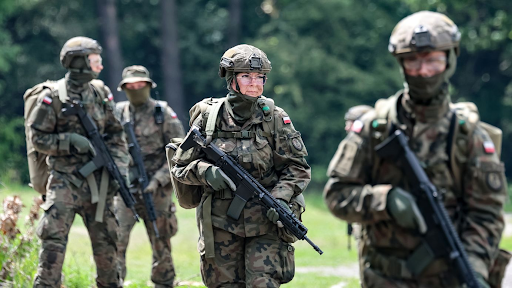
On the ground, the mood is a tense mix of resolve and exhaustion. In the Polish town of Orzysz, home to a newly expanded French-led battle group, soldiers dig fresh anti-tank obstacles along a forest road leading to the Russian exclave of Kaliningrad.
“Two years ago, we were talking about counter-terrorism in the Sahel,” said Lieutenant Paul Delacroix, 29, a platoon commander with the 1st Foreign Cavalry Regiment. “Now I’m digging a trench facing a Russian motor rifle division. The politicians can call it ‘deterrence.’ We call it what it is.”
In Moscow, the reaction has been predictably volcanic. Foreign Ministry spokesperson Maria Zakharova accused France of “rehearsing a crusade against the Russian people,” while state television has begun running graphics showing French nuclear facilities bracketed by crosshairs. Behind closed doors, however, some Kremlin insiders appear rattled. A former Russian defense official, speaking on condition of anonymity, told *The Daily Digest* that “Macron is more dangerous than any American president. The Americans calculate. The French have a romantic death wish.”
The European public remains divided. In Germany, where Chancellor Scholz has reluctantly approved the permanent stationing of a brigade in Lithuania, anti-war protests have resumed. In Finland, the newly NATO members, reservists are quietly refreshing their cold-weather combat skills. And in France, a recent poll found that 58% of respondents now support a “European defense union with shared nuclear command,” a figure that has doubled since 2022.
As the sun sets over the Seine, Macron’s Elysee Palace burns late-night oil. The president is reportedly reviewing a classified “Plan Renard,” a step-by-step escalation matrix that includes everything from cyber retaliation to a naval blockade of Russian gas shipments in the Baltic.
Asked whether Europe is truly preparing for war, a senior French diplomat put down his coffee and spoke with weary precision.
“We are preparing so that war does not happen. But you prepare for what you fear, not what you hope for,” he said. “Right now, Europe fears that Russia believes we are afraid. That is a mistake Moscow must not be allowed to keep making.”
For now, the drills continue. The ammunition ships sail east. And across a continent that swore “never again,” the quiet sound of tank treads on cobblestone has returned.